
How to Get Court Records
Know what you need before you ask. That means the court plus the exact paper or docket event. A vague request for “the record” slows everything down. MiCOURT Case Search can pull up public case and register information for Menominee County. It stops short of the full case file. Once you have a case number, a year, or a caption, take it to the clerk who holds the file and ask for something specific: inspection, a register-of-actions printout, a named document, a plain copy, a certified copy, or a transcript.
Different channels do different jobs. MiCOURT works well for a public search. For copy procedures, older cases, restricted results, or payment questions, call the right clerk. A trip to the courthouse lets you use the court’s public-access process. Staff can tell you whether a public terminal or inspection is an option. Mail a narrow copy request only after the clerk confirms the fee, the recipient, and how to pay. The general circuit contact form can route a question. But do not treat it as a formal records-request form.
- Use MiCOURT to identify the court, case number, and public register information.
- Call or visit the responsible clerk for inspection, copies, certification, or an unavailable document.
- Ask about a courthouse public terminal when the online result is incomplete.
- Send a mail request after confirming the record, fee, and acceptable payment.
- Use the county FOIA route only for county administrative records, not judicial case files.
Menominee Court Records Custodians
Which office holds the file depends on the court level. The Menominee County Clerk doubles as Circuit Court Clerk. It receives, processes, and opens circuit filings. The district clerk handles 95A District Court matters. Probate records sit with a separate Register of Probate. Read the court name on any search result before sending a request. A traffic or small-claims file sent down the circuit channel will likely just bounce back.
41st Circuit Court records
Marc Kleiman is the Menominee County Clerk and Circuit Court Clerk. Use this route for circuit filings, registers, and circuit copy questions.
(906) 863-9968
95A District Court records
Use the district clerk for traffic, civil-infraction, misdemeanor, small-claims, landlord/tenant, ordinance, and district civil records.
(906) 863-8532
Menominee Probate records
Lisa Frost, Register of Probate, is the separate contact for probate court records and access questions.
(906) 863-2634
All three custodians operate out of the Menominee courthouse at 839 10th Avenue, Menominee, MI 49858. Published clerk hours run Monday through Friday, 8:00 a.m. to 4:30 p.m., and the office closes on county holidays. Call ahead if your visit involves archived files, transcripts, certification, or a large inspection request.
Types of Court Records
Think of the docket, also called the register of actions, as the court’s chronological index. Behind it sit the actual documents: a complaint or petition, summons, proof of service, answer, motion, response, affidavit, exhibit, order, judgment, transcript, financial statement, garnishment, satisfaction, or appeal paper. Keep in mind that a public case does not guarantee every item is scanned, downloadable, or free of redaction.
Match your request to your question. A judgment is not a complaint. A transcript, prepared by a court reporter or authorized transcriber, is not the same as a docket printout. A proof of service only records service activity. A later order or judgment states what the court actually did. The public file can also hold fewer pages than the clerk’s full internal record, since confidential and restricted material is handled separately.
Menominee Court Records Are Indexes
Think of a docket entry as a pointer, not the file itself. A motion, order, judgment, or payment hit the record on a certain date. That is what the entry tells you. What it usually cannot give you is the full text or every exhibit behind that line. So work the Menominee County court docket in two steps: pull the public register for the title and date. Then ask the clerk for that one document by name. That keeps false matches, extra copying, redaction work, and delay to a minimum.
MiFILE plays a different part. Registered filers use it to submit and serve papers in Michigan. It is not an archive anyone can browse. A document sent through MiFILE may sit unaccepted or unindexed for a while. Finding a public case still runs through the MiCOURT and clerk process. That holds no matter how the filing went in.
What a Court Record Contains
What a court record holds depends on the case type. That is the good news. Most requests can be built from a few plain pieces: the case number, the year, the caption, the document name, and the filing or hearing date. No case number yet? Ask the clerk for the public register of actions for one court and a narrow stretch of time. Leave extra personal identifiers out of the request. The clerk can also tell you whether a redacted public version of the record exists.
| Case header | Court, case number and year, case type, caption, parties, and filing date when public. |
|---|---|
| Register of actions | Chronological entries such as filings, settings, orders, judgments, and disposition information. |
| Documents | Public pleadings, service records, motions, orders, judgments, and related papers that the clerk can release. |
| Hearing material | Public event entries and, when separately requested, an available transcript or hearing-related document. |
| Financial entries | Public costs, balances, satisfaction, or other financial fields only as the record displays them. |
Menominee Court Record Request Details
A tight request helps the clerk find the file and price the work. Name the court first. An adult felony can open under a 95A number. It can then carry on under a different 41st Circuit number. So the court matters more than the case style. For probate records, contact the Register directly instead of assuming that an empty public search means no access. And if all you want is the docket, say "public register of actions" or "docket entries." Then order any single document separately.
- Name the court, case number and year, caption, and approximate filing or document date.
- Identify the exact paper, register entry, transcript, or copy requested.
- Specify inspection, ordinary copy, certified copy, or another format and paper or electronic preference.
- Ask for the fee estimate, payment method, and turnaround before sending money or a large order.
- If access is limited, ask for the governing rule or order and whether a redacted public version is available.
Need the number before you request anything? The Menominee County case search is the natural next step, and it helps separate the public case you want from another matter filed under a similar name.
Menominee Court Records by Mail
Mail works best once the clerk has told you where the case belongs. Send the request to the right office. That may be the circuit clerk, the 95A clerk, or the Register of Probate named on the case. Include the case number, year, caption, the document you want, and the copy type. Ask up front whether payment rides along with the request or waits for a quote. Menominee County publishes no single mailed-copy workflow. So treat a traffic payment instruction as just that. Do not read it as a copy-order rule too.
Certified case copies have no countywide fax, email, or dropbox channel. The circuit contact form can carry a routing question. A message through it is not itself a records request, though. Avoid sending protected identifiers on any channel the clerk has not confirmed. If you plan a courthouse visit, call ahead about public-terminal access. The county pages post no separate terminal schedule.
Certified Copies and Fees
A certified copy and a plain copy are two different products. Certification means the clerk vouches that the copy matches the court record. Nothing more. It does not convert a pleading or allegation into any kind of factual finding. State guidance sets a general formula under MCL 600.2546. That formula is $10 for certification plus $1 per page. Menominee publishes no complete local copy-fee menu. So confirm every amount, payment option, and availability with the clerk before you send anything.
| Requested product | Published guidance | Menominee instruction |
|---|---|---|
| Certified court copy | $10 certification plus $1 per page, generally | Confirm the local amount, record availability, and payment method before ordering. |
| Ordinary copy or register | No complete local fee menu located | Ask the responsible clerk for the current copy charge and delivery options. |
| Transcript or exemplification | Separate product and rules may apply | Identify the intended use so the clerk or court reporter can direct the request correctly. |
The Michigan certification-fee statute is the source depicted here.
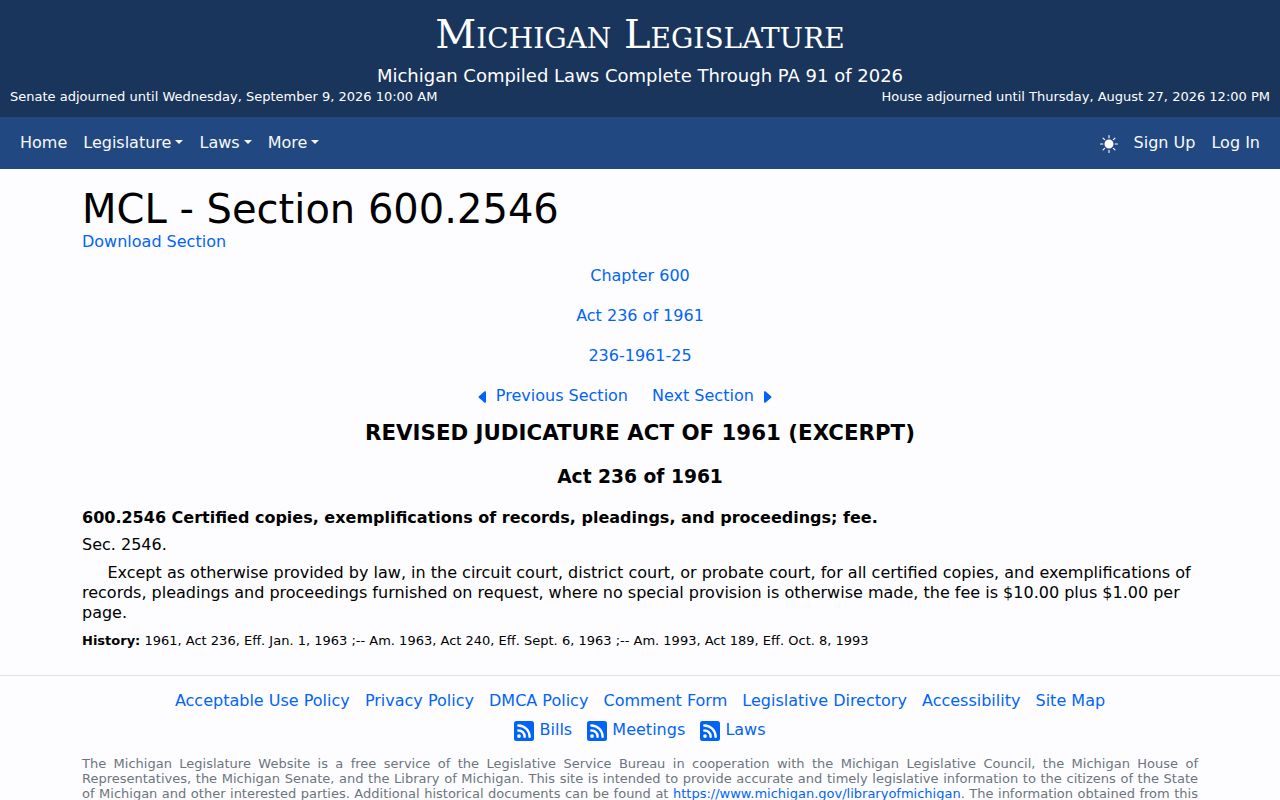
That state formula is only a starting point for a Menominee court-record request. The clerk has to confirm the current local charge and whether the paper you want can be certified at all.
Menominee Court Record Copy Choices
Order the smallest product that answers your need. Inspection alone may let you read a public file. A plain copy fits when you need to keep the text. Certified copies matter only where the receiving organization demands clerk certification. Exemplified copies add another layer of authentication. So never assume one from a request for a certified record.
Payment records are their own category. A traffic payment receipt is not automatically a docket copy. A FOC account statement may not be the last financial entry in a circuit register. Sheriff service records, prosecutor files, police reports, jail records, probation material, and state driver records often sit with a different office entirely. Ask the clerk for the court document you need. Then go to the other agency directly for anything outside the court file.
Menominee Court Records Fee Questions
Menominee's local pages promise no universal turnaround. There is no one-page request form, and no single price across case types. The difference matters when a file is archived, runs long, needs redaction review, or must be certified. Get the estimate before you mail a check or money order. Name the court and the product in your question. Circuit fines, district traffic balances, and filing fees are not interchangeable.
For a big request, have the clerk price the public register separately from individual documents. A narrow first request often shows which extra papers are worth ordering. Keep one caution in mind. A fee estimate can move if the clerk finds more pages or a restriction that requires review.
Public Access and Sealed Records
Court rules and judicial-record statutes govern access to Michigan case records. The county's ordinary FOIA workflow does not apply. MCR 8.119 controls public inspection and copying of court records. MCR 1.109(D)(9) covers protected personal identifying information and redaction. The original files stay in court custody. Access can be limited when a case or document is sealed, nonpublic, juvenile, adoption-related, mental-health-related, or otherwise restricted.
Ask for the public portion first. When a document carries protected data, see whether a redacted copy can be released. If the clerk says material is sealed or unavailable, request the rule or order behind that answer. Ask whether the sealing order itself is public. A restricted result tells you the access status, nothing more. It is not proof that no case exists.
Michigan access rules: MCR 8.119 controls judicial record access. MCR 1.109(D)(9) protects specified personal information through redaction. MCL 600.2546 addresses certification fees. These authorities apply to court files, while county FOIA serves a separate administrative-record route.
Menominee Court Records FOIA Boundary
Need county paperwork instead of a case file? Menominee County's FOIA page lays out the process for administrative records of county government. It promises an answer within five business days. An extension of no more than ten business days is allowed. Labor, copying, mailing, or digital-media costs may apply. If an estimate runs past $50, the county can demand a 50% deposit. That deposit must be paid before anything is released.
None of that governs a court docket or case file. Under MCL 15.232, Michigan's FOIA leaves the judicial branch out of its definition of a public body. So route requests for case files to the court clerk under the court-record rules. Save FOIA for the county administrative material it truly covers.
For the step-by-step administrative process, the county's FOIA instructions show what that official page requires of an applicant.
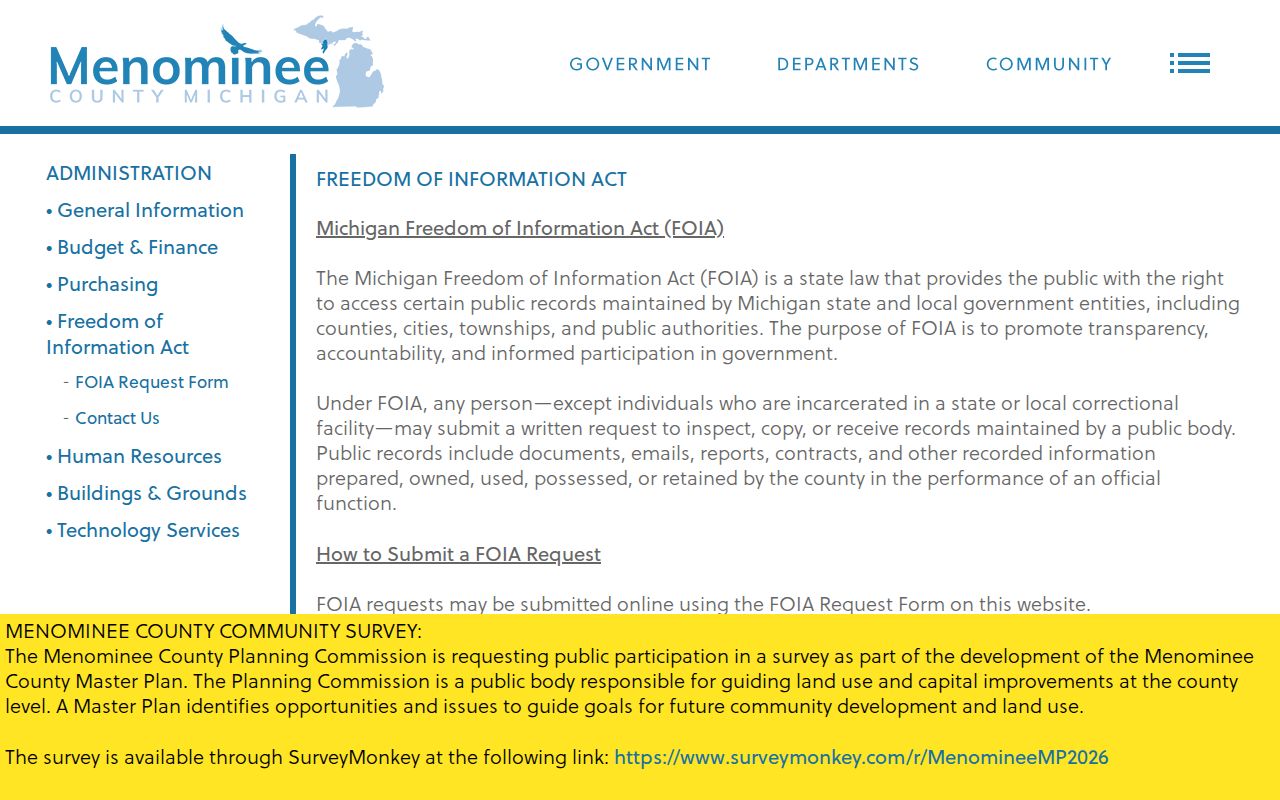
That county page covers administrative records only. It is no substitute request path for Menominee judicial case records.
Menominee Court Record Restrictions
Redaction exists for a reason. Social Security numbers, dates of birth, driver-license and state-ID numbers, passport numbers, and financial-account details all get shielded from public view. Leave them out of your Menominee County court-record request. Add them only if the clerk insists. The clerk can also split the difference. The office may release a public register while holding back a document, or issue a redacted filing while keeping an attachment sealed.
If an access dispute comes up, write things down as they happen. Note the court you contacted, the case number or exact query, the date, the document you asked for, the clerk's answer, and any rule or order cited. Those notes let you tell apart an unindexed file, a wrong-court docket search, a seven-year criminal-search filter, and a restriction that truly applies. A sealed file calls for one pointed question to the clerk. Casting a wider net helps no one. The line between court records and other files is drawn by statute. Michigan's FOIA definitions show where the legislature set it.
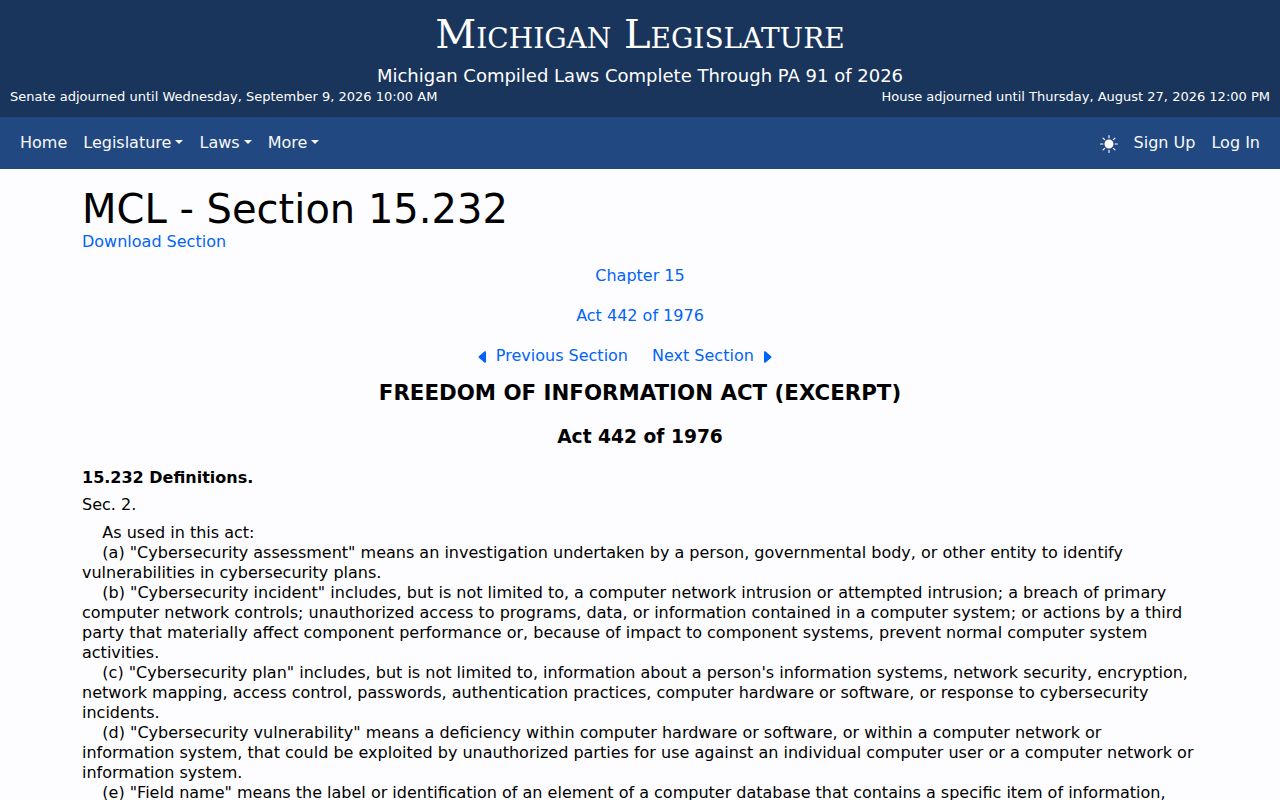
That statutory line keeps a Menominee court-record request pointed at the right office. The clerk, not a broader records hunt, is who weighs public-access status.